
Vehicle Lift Guide: 2 Post vs 4 Post vs Scissor
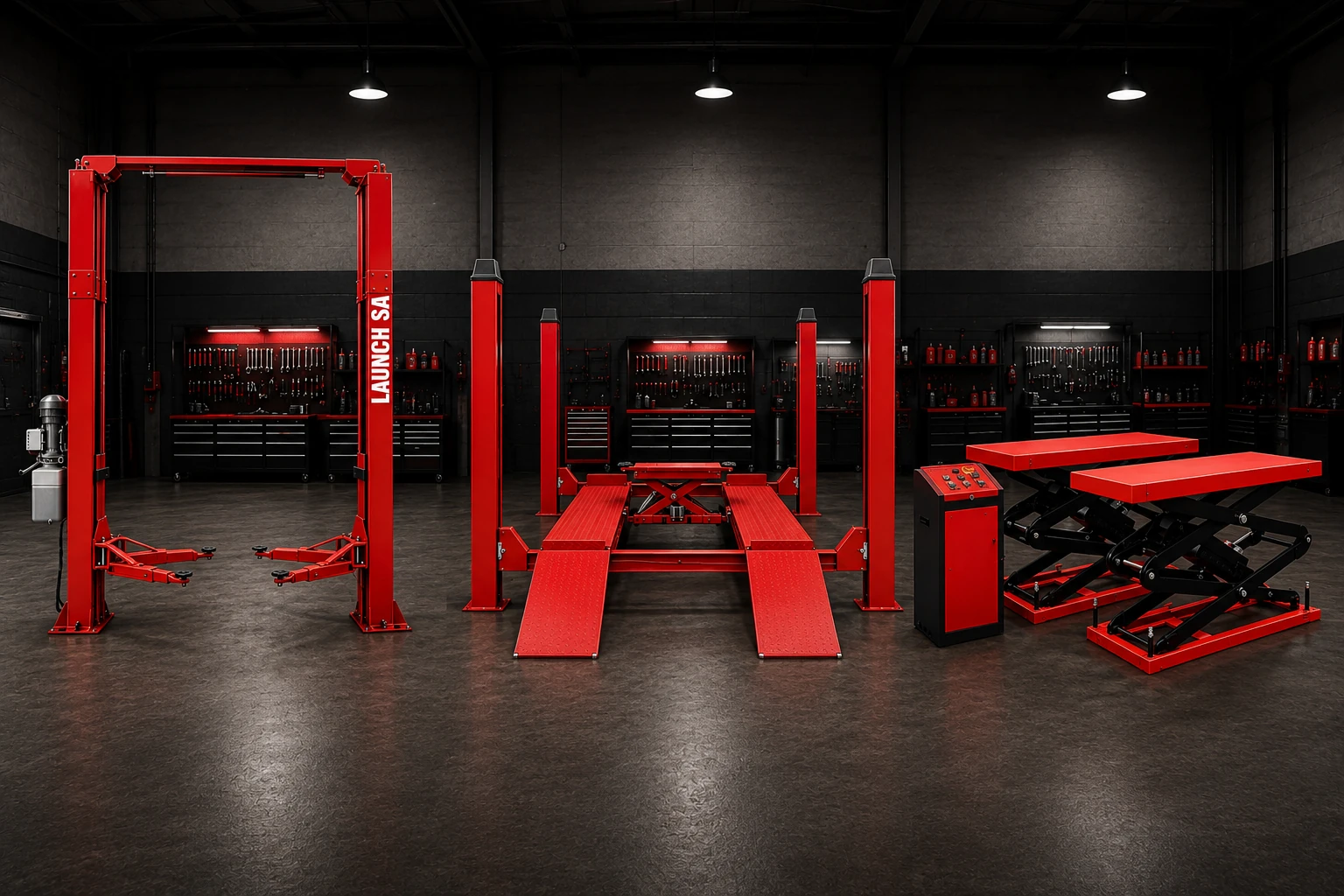
A vehicle lift is the backbone of any workshop. It sets how fast your technicians work, what vehicles you can take on, and how much you can fit into your floor space. But with three main
A vehicle lift is the backbone of any workshop. It sets how fast your technicians work, what vehicles you can take on, and how much you can fit into your floor space. But with three main types to choose from — the 2 post lift, the 4 post lift and the scissor lift — it’s not always obvious which one suits your bay.
Each design has a clear job it does best. This guide explains how the three compare on capacity, floor space, the type of work they’re built for and cost, so you can choose the right vehicle lift the first time.
Quick comparison
| 2 Post Lift | 4 Post Lift | Scissor Lift | |
|---|---|---|---|
| Best for | General repair, full underbody access | Drive-on service, alignment, parking/storage | Tyre bays, alignment, space-saving setups |
| Wheels-free access | Yes | No (vehicle on its wheels)* | Some models (with jack) |
| Floor space | Compact footprint | Larger footprint | Smallest / flush-mount options |
| Ease of drive-on | Position arms under pickup points | Easiest — drive straight on | Drive-on / flush-mount |
| Typical capacity | ~4–5.5 ton | ~3.6–6.5 ton | ~2.8–4.5 ton |
| Alignment-ready | With extra equipment | Yes (turnplates / slip plates) | Yes (alignment scissor models) |
*A rolling jack accessory lets a 4 post lift raise the wheels for brake and suspension work.
2 Post Lifts: the workshop all-rounder
The 2 post lift is the most common choice for general repair work. The vehicle is raised by two columns using lifting arms placed under the manufacturer’s pickup points, which leaves the wheels hanging free. That “wheels-free” access is the big advantage — technicians get clear, all-round reach to brakes, suspension, the exhaust and the full underbody, making it ideal for the widest range of jobs.
There are two things to understand when choosing a 2 post lift:
Clear-floor vs baseplate. A clear-floor (baseless) design keeps the floor completely open between the columns, so there’s nothing to trip over or roll a jack across — the hydraulic and cable lines run overhead instead. A baseplate model runs those lines through a plate across the floor, which can simplify installation where overhead routing isn’t ideal. In our range, the SAL240SC is a clear-floor (N-shape) 5.5-ton lift, while the SAL240SB is a baseplate (U-shape) version of the same capacity.
Symmetric vs asymmetric. This affects how the vehicle sits between the columns and how easily doors open once it’s up. Many quality lifts offer both configurations as an option.
Good 2 post lifts are built around safety: dual hydraulic cylinders with chain or cable equalisation to keep both carriages moving together, automatic mechanical safety locks, a low-voltage (24V) control box, and an anti-explosion valve so the lift lowers safely if a hydraulic line fails. Reputable units are CE certified and proof-tested above their rated load.
Choose a 2 post lift if: you do general mechanical repair and want the fastest underbody access in a compact footprint.
4 Post Lifts: drive-on strength, alignment and parking
The 4 post lift raises the vehicle on two runways supported by four columns. The vehicle stays on its wheels and you simply drive straight on, which makes it the easiest and most stable lift to load — especially for heavier vehicles, long-wheelbase bakkies and repeated daily use.
Because of that stability and higher capacity, the 4 post lift is the go-to for three jobs in particular:
- Wheel alignment. With turnplates at the front and slip plates at the rear, a 4 post lift becomes a proper alignment bay. Our SAL455 series includes adjustable turnplate and sliding-plate positions for exactly this.
- Heavy and frequent service work. Drive-on loading and capacities up to 6.5 ton (the SAL465WH) suit busy general service and larger vehicles.
- Parking and storage. A parking-spec 4 post lift like the SAL436 lets you stack two vehicles in one bay — useful for dealerships, valet storage or simply making space.
The trade-off is access: because the wheels sit on the runways, you can’t reach the brakes or suspension as freely as on a 2 post lift. The fix is a rolling jack (the “WH” models include one), which sits on the runways and lifts the wheels free when you need wheels-off work. For alignment bays where floor level matters, a recessed pit rack version keeps the runways flush with the floor.
Choose a 4 post lift if: you focus on alignment, service larger or heavier vehicles, or need vehicle storage as well as repair capability.
Scissor Lifts: compact, flush and tyre-bay friendly
The scissor lift raises the vehicle on a platform driven by a scissor-action mechanism beneath it, rather than columns at the side. With no posts in the way and flush-mount installation options, scissor lifts are the most space-efficient choice and keep the area around the vehicle completely open — which is why they’re popular in tyre bays, alignment shops and workshops where floor space is tight.
Scissor lifts come in a few forms:
- Full-rise scissor lifts raise the whole vehicle to working height. Our PL-E35L is a flush-mounted full-rise model with a 3,000–3,500 kg capacity, around 2,050 mm of lift and a low 330 mm minimum height, with a pneumatic safety locking system and anti-surge protection.
- Alignment scissor lifts such as the PL-D45 (4.5 ton) add built-in turnplate and slip-plate provision for four-wheel alignment, with safety teeth and anti-explosion protection.
- Mid-rise / low-level lifts (like the single-bellow BL500-style platform) raise the vehicle a short distance — perfect for quick tyre, brake and bodywork tasks where you don’t need full standing height.
The consideration with scissor lifts is access underneath: the platform and mechanism sit below the vehicle, so all-round underbody reach isn’t quite the same as a 2 post lift. For their intended jobs — tyres, alignment and fast turnaround work — that’s rarely a problem.
Choose a scissor lift if: you run a tyre or alignment bay, are short on floor space, or want a flush-mounted lift that disappears into the floor when not in use.
How to choose the right vehicle lift
The best lift depends on your specific bay and the work you do. Run through these:
What work do you do most? General repair leans 2 post; alignment and heavier or storage work lean 4 post; tyres and tight spaces lean scissor.
What do you lift? Match capacity to your heaviest regular vehicle, with margin to spare. Passenger cars and light bakkies are comfortable on most lifts; heavier 4x4s and light commercials push you toward higher-capacity 4 post or 5.5-ton-plus 2 post models.
How much space and ceiling height do you have? A 2 post lift needs enough overhead clearance for a raised vehicle plus the overhead bar; scissor lifts need the least room and can be flush-mounted; 4 post lifts need the largest footprint but modest height.
What’s your power supply? Many workshop lifts run on 380V three-phase, though some scissor and low-level models offer 220V single-phase. Confirm what your premises supports before buying.
What’s the floor like? Lifts need a sound, level concrete slab of adequate thickness. This matters for safe installation regardless of lift type — get the floor checked first.
Do you need to grow into alignment or storage? If alignment is on the horizon, a 4 post or alignment scissor lift saves buying twice. If you need to park two vehicles in one bay, a parking-spec 4 post lift earns back its footprint.
Safety and installation come first
Whichever type you choose, a lift is only as safe as its build and its installation. Look for mechanical self-locking safety devices in every column or carriage, a secondary safety system, low-voltage controls, anti-explosion hydraulic valves and recognised certification, and always have lifts installed and commissioned by trained staff on a correctly specified floor.
Buy and view lifts in South Africa
At Launch Technologies South Africa we supply the full range — Launch 2 post lifts (SAL240 clear-floor and baseplate), 4 post lifts (SAL455, SAL465 and SAL436 parking and alignment racks) and Road Buck scissor lifts — with bulk stock for fast delivery across Southern Africa. You can see and test the equipment in person at our heavy machinery showroom in Bedfordview, Germiston, and our trained team handles demonstrations, delivery coordination and installation guidance.
Not sure which lift fits your bay? Browse our vehicle lifts and hoists, or get in touch and we’ll help you spec the right vehicle lift for your space and your workload.
Frequently asked questions
What is the difference between a 2 post lift and a 4 post lift? A 2 post lift raises the vehicle by its underbody pickup points, leaving the wheels hanging free for full access — best for general repair. A 4 post lift raises the vehicle on its wheels along two runways, making it the easiest to load and the best base for wheel alignment, heavier vehicles and parking. Add a rolling jack to a 4 post lift when you need wheels-off access.
Is a scissor lift as good as a 2 post or 4 post lift? For its intended work — tyres, alignment and tight spaces — a scissor lift is excellent and saves the most floor space, with flush-mount options. For all-round underbody repair, a 2 post lift still gives the best access.
Which vehicle lift is best for wheel alignment? A 4 post alignment lift with turnplates and slip plates, or a dedicated alignment scissor lift, are both purpose-built for four-wheel alignment.
What capacity vehicle lift do I need? Choose a lift rated comfortably above your heaviest regular vehicle. Our 2 post lifts are rated at 5.5 ton, 4 post lifts from 3.6 to 6.5 ton, and scissor lifts from roughly 2.8 to 4.5 ton — there’s a fit for most workshops.
Can I see the lifts before buying? Yes — visit our Bedfordview showroom to view 2 post, 4 post and scissor lifts in person, with guidance from our team on space, power and installation.
Share this article
A quick overview of the topics covered in this article.
Follow us
Latest articles

September 23, 2026
September 23, 2026