
Is there One Powerful Diagnostic Machine For All Cars?
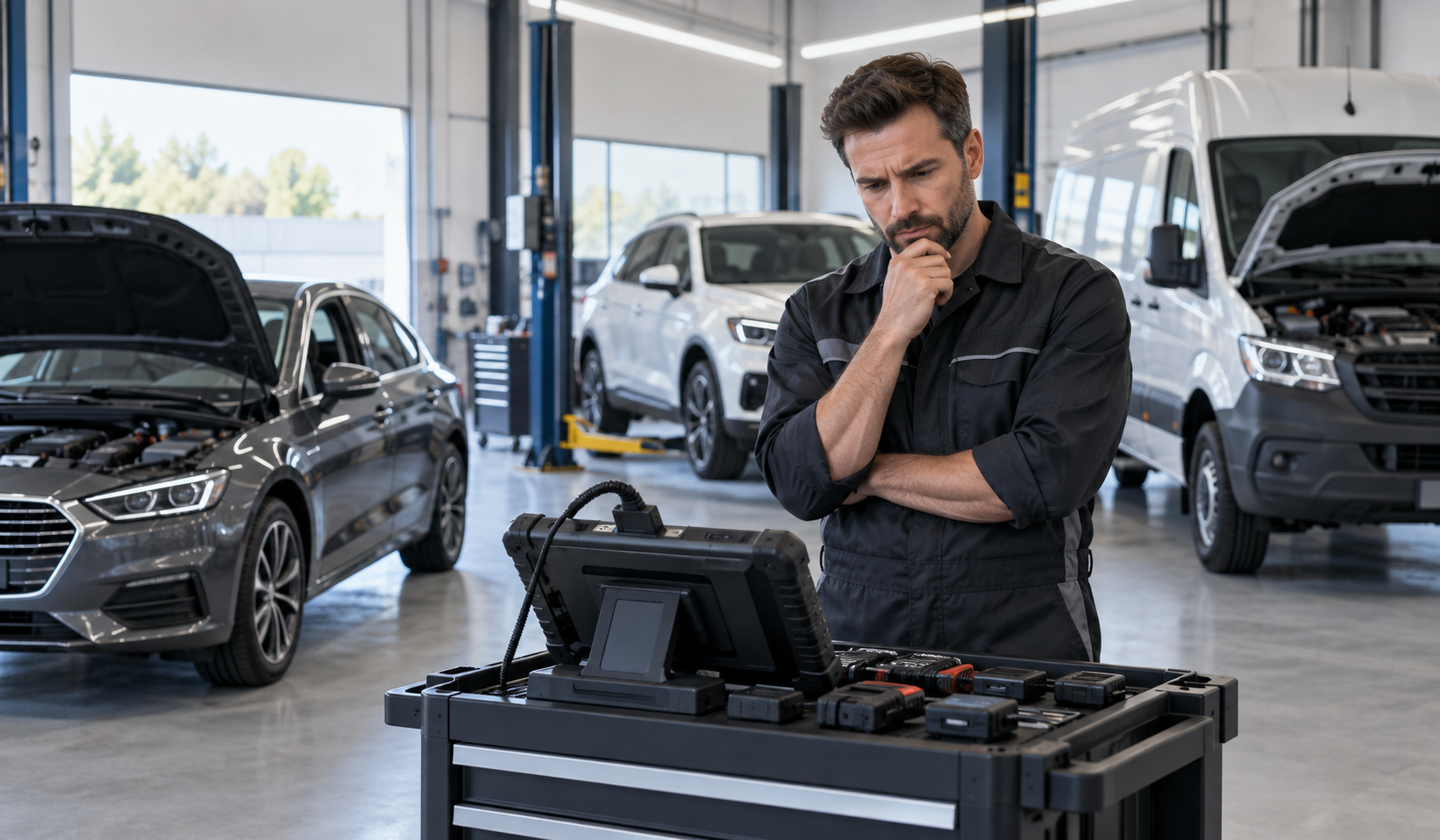
If you’ve ever searched for a diagnostic machine for all cars, you’ve probably come across some bold marketing claims: “works on every make and model,” “one tool does it all,” “universal coverage guaranteed.” It’s an appealing
If you’ve ever searched for a diagnostic machine for all cars, you’ve probably come across some bold marketing claims: “works on every make and model,” “one tool does it all,” “universal coverage guaranteed.” It’s an appealing idea, especially for independent workshops trying to service everything from a Toyota Hilux to a BMW without buying five different scan tools.
But here’s the question workshop owners across South Africa keep asking us: is a truly universal diagnostic machine actually a real thing, or is it just clever marketing?
The honest answer is: mostly yes, with a few important caveats every workshop should understand before they buy. This article breaks down what a vehicle diagnostic machine can realistically do across brands, where the limits are, and how to choose equipment that genuinely earns its place on your workshop floor.
What Does “Works on All Cars” Actually Mean?
When a supplier says a tool is a diagnostic machine for all cars, they’re usually referring to its ability to communicate with a vehicle’s onboard computer systems through the standardised OBD-II port — a connector that’s been mandatory on most petrol vehicles sold in South Africa since the early 2000s, and on diesel vehicles a little later.
Because OBD-II is a shared standard, a well-built scan tool can physically plug into almost any car on the road and read basic fault codes and live data. That’s the foundation of “universal” coverage.
Where it gets more nuanced is everything beyond basic fault codes — deeper systems like ABS, airbags, transmission control units, ADAS (advanced driver assistance systems), and manufacturer-specific functions. This is where the quality of the diagnostic machine — specifically its software coverage, update frequency, and bi-directional control capability — makes a real difference.
So Is There Really a Universal Diagnostic Machine?
Yes — but “universal” should mean broad, professional-grade multi-brand coverage, not “does absolutely everything a factory dealer tool can do.” A quality vehicle diagnostics machine for all cars should be able to:
- Read and clear fault codes across most European, Asian, and American makes
- Access live sensor data to diagnose intermittent faults
- Perform bi-directional tests (actuating components, not just reading them)
- Handle service resets — oil, brakes, DPF, battery registration
- Support key programming and IMMO functions on many models
- Receive regular software updates as new vehicle models are released
This is exactly the level of coverage brands like Launch and ThinkCar are built around — professional multi-brand scan tools designed for independent workshops that need to service a mixed fleet of vehicles, not just one manufacturer.
A good real-world example is the THINKTOOL Master 2, a professional multi-brand diagnostic scanner that supports full-system diagnostics, ECU coding, and online programming across 12V and 24V vehicles — from Toyota, Volkswagen, and BMW to Ford, Nissan, Hyundai, and most other makes sold in South Africa. It’s the kind of tool that shows what “works on all cars” realistically looks like when it’s backed by genuine, regularly updated software rather than a marketing slogan.
What a genuinely honest supplier won’t promise is that one machine replaces every specialised tool in existence. Some jobs — such as certain ADAS camera calibrations, advanced OEM programming, or brand-specific security systems — may still call for an add-on module, a dedicated calibration tool, or an OEM-level system. That’s not a flaw in the machine; it’s just the reality of how modern vehicle electronics work.
Why This Matters for Workshops in South Africa
For independent workshops and mobile mechanics, buying the right diagnostic machine is one of the biggest equipment decisions you’ll make. Get it right, and one investment lets you confidently quote on Toyotas, Volkswagens, Fords, Hyundais, and bakkies alike. Get it wrong, and you end up with a tool that only really “talks” to a handful of brands, or one that needs constant paid add-ons just to stay useful.
This is a particularly common question we get from workshops searching for a diagnostic machine for all cars in South Africa — because vehicle parc here is genuinely mixed. A typical independent workshop in Gauteng might see European sedans, Japanese hatchbacks, Korean SUVs, and light commercial vehicles all in the same week. A narrow, single-brand tool simply can’t keep up with that variety.

What to Check Before You Buy
If you’re comparing a car diagnostic machine price against another, don’t just look at the number on the price tag. Ask these questions first:
- How many vehicle brands and models does it actually cover, and how often is that list updated?
- Does it do bi-directional tests, or only read codes? (This is the difference between a basic scanner and a true diagnostic tool.)
- Is local support and training available, or are you on your own if something doesn’t work?
- Can you see and test it in person before committing your budget?
- Is it backed by an authorised distributor who can supply genuine software updates, not a grey-import clone?
That last point matters more than most people realise. South Africa’s market has seen a rise in cloned and grey-market scan tools sold online that look identical to genuine units but lack proper update support — leaving workshops stuck with outdated software within months.
Seeing Is Believing
Because “does it really work on all cars” is such a fair and common question, the best way to answer it isn’t through a spec sheet — it’s by testing the tool on a real vehicle. At our Diagnostic Showroom in Bedfordview, Germiston, workshops and technicians can see Launch and ThinkCar diagnostic machines demonstrated live, ask questions, and compare coverage across different vehicle makes before buying anything.
We also maintain bulk stock of diagnostic machines, key programmers, TPMS tools, oscilloscopes, and ADAS calibration equipment, so workshops aren’t left waiting weeks for imported stock — and our team provides product training and technical support once you’re up and running.
Frequently Asked Questions
What can a diagnostic machine do? A quality diagnostic machine reads fault codes, displays live sensor data, performs system tests (bi-directional control), resets service and warning lights, and — depending on the model — supports key programming, TPMS servicing, and ADAS calibration functions.
What is the best diagnostic machine for cars? The “best” tool depends on your workshop’s mix of vehicles. For general independent workshops handling a wide range of makes, a professional multi-brand tool such as a Launch or ThinkCar unit typically offers the broadest, most cost-effective coverage. Specialist workshops focused on one brand may still benefit from a dealer-level tool for that specific manufacturer.
Is there a universal diagnostic machine for all cars? There’s no single tool that replicates every manufacturer’s dealer-level system for every function. However, professional multi-brand diagnostic machines get very close, covering the vast majority of makes, models, and everyday diagnostic and service needs on the road today.
Where can I find a diagnostic machine for all cars near me? Workshops in Johannesburg, Pretoria, Durban, and across Gauteng can view and test diagnostic machines in person at our showroom in Bedfordview, Germiston — with stock also available for workshops throughout South Africa and the wider Southern African region, including Namibia, Botswana, Zimbabwe, Zambia, Mozambique, Eswatini, and Lesotho.
How much does a car diagnostic machine cost in South Africa? Pricing varies significantly depending on brand coverage, functions (basic code reading versus bi-directional testing, key programming, or ADAS calibration), and whether the unit is a genuine, supported product or an unsupported import. It’s worth comparing capability, not just price, before deciding.
Final Thought
A diagnostic machine for all cars isn’t a myth — but it also isn’t magic. The real story is that professional multi-brand tools have come a very long way, and for the vast majority of workshops, one well-chosen machine can realistically cover the everyday diagnostic needs of almost any vehicle that rolls through the door. The key is understanding what “universal” really means, and choosing a tool — and a supplier — that’s honest about both its strengths and its limits.
If you’d like to see a tool like the THINKTOOL Master 2 in action on your own workshop’s typical vehicles, visit our Diagnostic Showroom at 23 Boeing West Road, Bedfordview, Germiston, Monday to Friday 8:00 AM–5:00 PM or Saturday 8:00 AM–1:00 PM.
Share this article
A quick overview of the topics covered in this article.
Follow us
Latest articles
September 23, 2026
September 23, 2026